Bricks Breaker Quest
- 4.2
- Rating
- 100.00M
- Installs
- Free
- Price
 Analysis by App-foxy
Bricks Breaker Quest is the kind of arcade game I can open without preparing myself for a long session. I tap, aim, watch a cluster of balls ricochet through colored blocks, and decide whether I want one more attempt. That simple rhythm explains much of its appeal: it asks for attention, but not a large commitment. After spending time with it, I found that its real test is not whether the first few sessions are enjoyable. They are. The more useful question is whether the game still feels worth opening once the novelty of breaking blocks has settled into a familiar routine.
My answer is cautiously positive. This is a free arcade game from mobirix that works best as a short, repeatable distraction rather than as a deep substitute for a larger game. It has enough tactical aiming to keep the basic interaction from becoming completely automatic, and its broad audience helps explain why it has passed 100 million installs. At the same time, the core loop is deliberately narrow. If you need a constantly changing adventure, a strong story, or a competitive community, you will probably outgrow it.
What the first week feels like
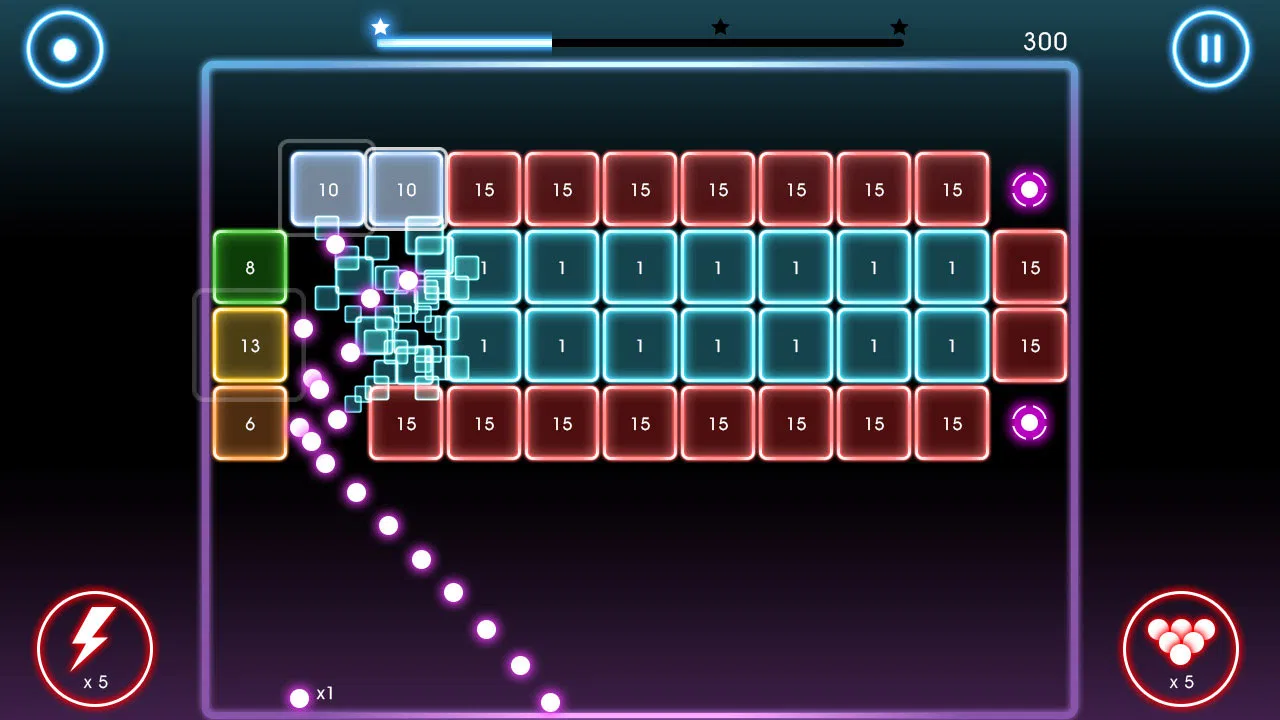
The opening appeal comes from how quickly the game communicates its idea. You aim a launch, release the balls, and let angles do the work. Blocks disappear as they are hit, while the next move becomes a small geometry problem: where can the first ball enter, and how can the rebound reach several targets instead of wasting the shot on one isolated piece? I like that the game makes a basic action feel slightly more thoughtful without turning it into a complicated puzzle interface.
You May Also Like

 Blood Strike: 2.5 Anniversary
Blood Strike’s Loadouts Turn Every Drop Into a Tactical Gamble
A close look at Blood Strike’s custom loadouts: how fast access to signature weapons reshapes its battle royale rhythm, rewards preparation, and narrows the gap between fights.

 Pandora - Music & Podcasts
Pandora’s Music Is Easy to Start, but Harder to Recover
Pandora’s strength is its low-effort path from a seed to a station. Its weak spot is how much confidence it asks you to place in connection, setup, and quiet recovery.

 8 Ball Pool
 Is Built on Rivalries, Rematches, and Routine
A close look at the rivalries, rematches, shared routines, and unanswered safety questions that turn a quick pool match into a persistent mobile community.

 Samsung Music
’s Quiet Strength Is Playing What You Already Own
Its reach comes less from spectacle than from dependable access to a personal library. That simplicity is both the app’s strongest retention engine and its ceiling.

 AccuWeather: Weather Radar
AccuWeather Review: A Quick, Clear Forecast for Everyday Decisions
For everyday plans, the best forecast is the one you can understand quickly. AccuWeather makes rain timing, radar, and local conditions easy to act on, with a few trade-offs.

 Hill Climb Racing
Why Hill Climb Racing Still Turns Crashes Into One More Run
A tiny car, a bumpy hill and one more upgrade: Hill Climb Racing keeps resurfacing because its simple chaos makes every near-miss feel personal.
More From Our News Desk



During a first session, the most satisfying shots are rarely the ones that simply clear the nearest block. They are the shots that enter a narrow gap, travel behind a row, and return through targets that looked safe a moment earlier. That creates a pleasant pause between decisions. You are not constantly tapping; you are studying the arrangement, choosing an angle, and then watching the result unfold. For a phone game, that delayed payoff gives each move more personality than the short store summary suggests.
The game is especially comfortable in situations where I have only a few minutes. I can play while waiting for an appointment, during a short break, or when I want something more interactive than scrolling. It does not require the emotional investment of a role-playing game, and it is less demanding than an action title that expects quick reactions. The focus is on planning a shot rather than controlling a character in real time, so I can play at my own pace.
That does not mean every early session is equally smooth. A poor opening angle can leave a frustrating number of blocks in awkward positions, and the result may feel more like damage control than clever play. The game’s physics are part of its charm, but they also make outcomes feel less direct than in a conventional match-three or fixed-grid puzzle. Players who want every mistake to be clearly their own may find the rebounds a little unpredictable.
Why the basic loop works
The strongest design choice is the separation between planning and spectacle. I make one meaningful decision, then the game gives me time to read the chain of impacts. That makes the experience relaxing in a way many arcade games are not. There is pressure to choose well, but not the frantic pressure of a timer-driven game. The store summary calls the experience a way to relax your mind, and in ordinary use I can see why that description fits the mood, even though a difficult board can still demand concentration.
My most useful early habit was to stop aiming only at the largest visible group. Instead, I look for a route that lets the first ball enter low and return upward, or enter near a wall and use the rebound to reach the opposite side. A shot that appears less powerful can create more total contact because it stays in motion longer. This is a small but important shift: the game rewards the quality of the path, not just the apparent number of blocks in front of the launcher.
Another practical tip is to avoid rushing the next attempt after a strong result. The board may look easier because several blocks have disappeared, but the remaining pieces can create a worse angle for the following turn. I found it better to inspect the new arrangement for a moment and identify which block is likely to become dangerous if left alone. That habit turns the game from casual tapping into a light planning exercise, especially when the board starts to fill with higher obstacles.
Who will enjoy the first sessions
I would recommend the opening experience to people who enjoy compact puzzle loops, gentle arcade physics, and games that can be played with one hand. It is also a reasonable choice for someone who wants a low-pressure alternative to reflex-heavy titles. The age rating is Everyone, which matches the straightforward presentation and accessible premise. Families should still remember that the game includes optional purchases, so a shared device may deserve the usual purchase controls.
It is less suitable for someone who needs a clear campaign with a memorable ending. The pleasure here comes from improving decisions and continuing through more boards, not from discovering characters or completing a dramatic narrative. Likewise, if you prefer direct control and immediate feedback, watching a chain of balls finish may feel too passive. The first week is strongest when you enjoy anticipation as much as action.
What remains after the novelty fades
The month-to-month value depends on whether the basic shot continues to feel like a small puzzle rather than a repeated animation. In my experience, it can remain useful as a habit because the commitment is so low. I can play a few rounds, stop without losing an evening, and return later without needing to remember a complicated plot or rebuild a strategy from scratch. That makes it easier to keep on a phone than a larger game that demands regular, uninterrupted attention.
Still, the game’s long-term strength is consistency, not variety. The central action does not transform into a different genre after the first few sessions. You are still searching for favorable angles, watching rebounds, and managing the board that follows. If that loop is satisfying to you, the familiarity becomes calming. If it is not, additional time will not suddenly reveal an entirely different experience.
The public response suggests that many players find the format approachable: the game holds an average rating of 4.2 from roughly 602 thousand ratings. I would not treat that number as a guarantee that it will suit every player, but it does fit my impression of a polished, broadly accessible arcade title rather than an obscure experiment. The audience is large because the entry barrier is low, not because the game offers the depth of a premium strategy release.
For recurring value, I would use it as a reset between demanding tasks rather than as my only mobile game. A realistic routine might be playing a few rounds on public transport, then closing it before it turns into background noise. That approach preserves the satisfying part: each session has a clear beginning and end. If I keep playing automatically for a long stretch, the sound and movement can blur together, and the decisions start to feel less meaningful.
Small decisions that improve repeat play
One non-obvious strength is that the game supports a personal learning curve without explaining every useful idea in a tutorial. I gradually became better at recognizing when a wall rebound was worthwhile and when it merely delayed contact. I also learned to value a shot that opens the board for the next turn, even if it does not produce the biggest immediate clearance. This is where the game earns some staying power: improvement comes from reading situations, not only from waiting for a favorable layout.
A second insight is that a high-risk angle is not automatically a smart angle. A shot that looks capable of reaching many blocks may also spend too much time bouncing in a low-value area. When I began judging the likely final position of the balls, rather than celebrating the first few impacts, my results became more consistent. That is a useful distinction for new players: the objective is not merely to create a dramatic chain, but to leave the board in a manageable state.
A third practical use is mood management. Because the game is slow enough to pause mentally between launches, I can use it when I want a screen activity that does not demand constant urgency. However, that benefit has a limit. If I am already tired or impatient, a bad rebound can feel disproportionately annoying. The same relaxed pacing that helps during a quiet break can feel sluggish when I want immediate progress.
Maintenance, friction, and the reasons people leave
The maintenance burden is fairly light in the everyday sense. The current version is 2.1.14 and it runs on devices using Android 6.0 or later, so it remains accessible to many older Android phones. I appreciate that this is not a game that requires me to learn a large control scheme or maintain a complicated collection of equipment. Returning after a break is uncomplicated because the central interaction is easy to remember.
There is, however, a difference between low learning maintenance and low attention maintenance. To keep enjoying the game, I need to protect it from becoming an unconscious habit. The best way I found was to give each session a purpose: a few attempts while waiting, a quick change of pace, or a short challenge to improve my angle choices. Without that boundary, the game can become repetitive simply because its accessibility makes it easy to reopen.
The free entry is a clear advantage, but optional purchases ranging from $0.99 to $109.99 per item change how I evaluate the experience. A player who is happy to progress at a relaxed pace can treat the game as a free arcade diversion. Someone who dislikes purchase prompts or feels pressure to spend for smoother progress should approach it more carefully. I would not install it for a child on a shared device without checking the purchase settings first, even though the content itself is rated for Everyone.
That purchase range also affects the game’s long-term atmosphere. Optional spending can be harmless when it remains genuinely optional, but the presence of expensive individual items makes the free experience feel less self-contained than a paid arcade game. If I want a completely predictable cost, a premium alternative may be more comfortable. On the other hand, paying nothing and using the game only for short sessions is a perfectly reasonable way to enjoy what it does well.
Where fatigue starts
The main source of fatigue is repetition in the core action. The first time a difficult arrangement collapses through a clever rebound, it feels rewarding. After many similar turns, the same visual rhythm can lose its impact. The game does not need to be bad for this to happen; it is simply the natural limit of a focused arcade concept. Players who need frequent new mechanics should recognize that limitation before committing to it as a main game.
Another possible frustration is the tension between control and physics. You choose the launch direction, but the complete outcome depends on a long sequence of collisions. When a shot fails, I can usually identify a better angle in hindsight, yet there are moments when the board feels resistant to a clean plan. That uncertainty is part of the appeal for some players, but it can be irritating for anyone who expects a direct connection between input and result.
The game can also lose its relaxing quality when I approach every board as a test of perfect efficiency. I enjoy it more when I accept that some turns are about improving the next position instead of clearing everything immediately. This is an important trade-off: the title works as a calming arcade pastime when I play with flexible goals, but it becomes more stressful when I demand flawless outcomes from every launch.
Compared with a match-three game, Bricks Breaker Quest offers less choice during the action but more anticipation around trajectory. Compared with a traditional brick breaker, it feels more turn-based and deliberate because the shot is planned before the chain of impacts plays out. Compared with a premium puzzle game, it is easier to pick up but less likely to deliver a tightly authored progression. I would choose it over those alternatives when I want physics-based planning in short bursts; I would choose something else when I want story, competitive depth, or a fixed one-time purchase.
My long-term verdict
After the novelty fades, Bricks Breaker Quest earns space on my phone only if I treat it as a small recurring ritual rather than a complete entertainment destination. Its best qualities are clear: the controls are approachable, the aiming creates genuine little decisions, and the pace suits short breaks. The game’s large audience, with over 20 thousand written reviews alongside its broad rating base, is consistent with that accessible design, though popularity does not remove the repetition that some players will feel.
I would keep it installed for a friend who enjoys casual arcade puzzles, wants a free option, and likes improving through better angles rather than faster reactions. I would also suggest it to someone who wants a quiet game for waiting rooms or commutes, provided they are comfortable with optional purchases and a loop that stays focused on block-breaking. The most rewarding way to play is to study the board, aim for future positioning, and stop while the decisions still feel fresh.
I would skip it for a player who wants a rich narrative, constant novelty, or a competitive endgame. I would also skip it if purchase prompts are a major annoyance or if physics-based uncertainty makes me blame the game more than my own aim. A premium puzzle title would be a better fit for someone seeking a controlled, finite experience, while a faster arcade game would suit someone who wants immediate reactions.
Ultimately, Bricks Breaker Quest does not need to become a lifelong obsession to be worthwhile. Its value is in being dependable: open it, make a few thoughtful shots, enjoy the chain of impacts, and leave before the repetition takes over. I found that modest promise more sustainable than the idea of endless progression. As a free arcade game from mobirix, it is easy to try, simple to understand, and pleasant in the right-sized dose. For me, that is enough to recommend it—but as a compact habit, not as the only game I would want to play.
FAQs for Bricks Breaker Quest
01What is Bricks Breaker Quest?
Bricks Breaker Quest is a popular mobile game available on both Android and iOS platforms. The objective is to break bricks by aiming and shooting balls at them. With a variety of levels and challenges, it offers a simple yet addictive gameplay experience that appeals to casual gamers.
02How do I play Bricks Breaker Quest?
Playing Bricks Breaker Quest is straightforward. You aim your balls by swiping your finger across the screen and then release to shoot them. The goal is to break all the bricks on the screen before they reach the bottom. Each brick has a number indicating how many hits it needs to break.
03Are there in-app purchases in Bricks Breaker Quest?
Yes, Bricks Breaker Quest offers in-app purchases. Players can buy various power-ups and additional balls to enhance their gameplay. While the game is free to download and play, these purchases can help you progress more quickly through challenging levels.
04Does Bricks Breaker Quest require an internet connection?
Bricks Breaker Quest can be played both online and offline. However, certain features like daily rewards or updates may require an internet connection. Playing offline allows you to enjoy the game without any interruptions, making it a great option for travel or areas with limited connectivity.
05Is Bricks Breaker Quest suitable for all ages?
Bricks Breaker Quest is designed to be family-friendly and can be enjoyed by players of all ages. Its simple mechanics and engaging levels make it suitable for children, while the increasing difficulty and strategic elements provide a challenge for adults. Always monitor younger players to ensure appropriate in-app purchases.
Pros
- Addictive gameplay keeps you engaged.
- Smooth controls enhance user experience.
- Multiple levels for endless fun.
- Colorful graphics are visually appealing.
- Regular updates with new challenges.
Cons
- In-app purchases can get expensive.
- Ads can interrupt gameplay frequently.
- Difficulty spikes on certain levels.
- Limited power-ups without payment.
- Requires internet for some features.

Bricks Breaker Quest
Gallery